|
|
|
 |
|
| Siemens Make PLC S7 300 / 400 |
|
|
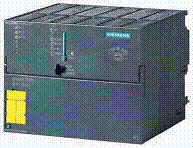
| SIMATIC S7-300 |
The modular PLC for innovative system solutions in the manufacturing industry |
The SIMATIC S7-300 has been designed for innovative system solutions with the focus on manufacturing engineering, and as a universal automation system, it represents an optimal solution for applications in centralized and distributed configurations: |
| • |
The ability to integrate powerful CPUs with Industrial Ethernet/PROFINET interface, integrated technological functions, or fail-safe designs make additional investments unnecessary. |
| • |
The S7-300 can be set up in a modular configuration without the need for slot rules for I/O modules. There is a wide range of modules available both for the centralized and the distributed configuration with ET 200M. |
| • |
The Micro Memory Card as a data and program memory makes a backup battery superfluous, and with it, part of the maintenance costs. In addition, an associated project, including symbols and comments, can be stored on this memory card to facilitate service calls. In addition, the Micro Memory Card allows simple program or firmware updates without the need for a programming device. The Micro Memory Card can be used during operation for storing and accessing data, e.g. for measured value archiving or recipe processing. |
| • |
In addition to standard automation, safety technology and motion control can also be integrated into an S7-300 PLC. |
| • |
Isochronous mode on PROFIBUS. |
|
|
|
|
|
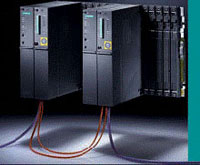
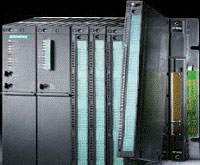
| SIMATIC S7-400 |
The Power Controller for system solutions in the manufacturing and process industries |
Within the Controller family, the SIMATIC S7-400 is designed for system solutions in the manufacturing and process automation. |
| • |
The S7-400 is especially suited for data-intensive tasks in the process industry; high processing speeds and deterministic response times guarantee short machine cycle times on high-speed machines in the manufacturing industry. The fast backplane bus of the S7-400 ensures efficient data transfer to central I/O modules. |
| • |
The S7-400 is used preferably to coordinate overall plants and to control lower-level communication lines with slave stations; this is guaranteed by the high communicationpower and the integral interfaces |
| • |
The power of the S7-400 is scalable thanks to a graded range of CPUs; the capacity for I/O is almost unlimited |
| • |
The performance reserves of the CPUs make it possible to integrate new functions without any other hardware investment, for example, processing of quality data, userfriendly diagnostics, integration into higher-level MES solutions or high-speed communication via bus systems. The S7-400 can be structured in a modular way without regard to slot rules; there is a wide variety of modules available both for centralized configurations and distributed structures. |
| • |
The configuration of the distribuded I/O of the S7-400 can be modified during operation. In addition, signal modules can be connected and disconnected under power (hot swapping). This makes it very easy to expand the system or replace modules in the event of a fault. |
| • |
Storage of the entire project data, including symbols and comments, on the CPU makes service and maintenance work easier. |
| • |
Safety engineering and standard automation can be integrated into a single S7-400 controller; plant availability can be increased through the redundant structure of the S7-400. |
|
|
|
|
|
|
|
|